Macbeth: Memes Project

Act 1 ; Scene 1

Summary of Act 1, Scene 1:

Act 1, scene 1 included three witches who made plans to meet with Macbeth. The ominous, eerie, and intense weather allowed for the reader to insinuate the beginning of worrisome troubles.

Significance of this meme: This scene was relatively short and provided the reader with very less details and insight into what would happen further on in the play. This meme is able to capture the evil intentions of the three witches, and the fact that the reader (at this point) and other characters are unaware of the witches’ wicked and menacing intentions. Through the facial expression of the woman in the meme, one is able to comprehend the malicious intent of the witches.

Literary Devices or Connections (to important aspects of the scene): At the end of the scene, the witches chant “fair is foul, and foul is fair.” This line indicates that one should not judge purely based on face value. This meme gives a glimpse of how one can hide “foul” intentions and act “fair.” In other words, one can know something that might be beneficial not telling others.

Act 1; Scene 2

Summary of Act 1, Scene 2:

King Duncan is informed that Macbeth and Banquo fought with great courage and violence. A captain describes for Duncan how Macbeth slew the traitorous Macdonwald. Ross enters and tells the king that the traitorous thane of Cawdor has been defeated and the army of Norway repelled. Duncan decides that Macbeth should be crowned Thane. Ross leaves to deliver the news to Macbeth.


Significance of this meme: This meme captures Macbeth’s victory as he is given the title of the Thane of Cawdor. Macbeth and Banquo both fought with great courage, yet Macbeth is awarded the title. This scene (and meme) indicate how Macbeth is unworthy of becoming Thane. The play suggested that the original Thane was traitorous and disloyal, foreshadowing that Macbeth will also follow the footsteps of this treachery and violence. The meme captures the idea that arguably, some supernatural forces (like the witches) played a crucial role in Macbeth’s title as Thane. This meme also portrays the idea of how Macbeth is unworthy of the title (due to evil deeds he will commit further on in the play) and how his victory was helped by numerous people and just not him. (Those who helped him win this title include the witches and Banquo, it wasn’t his sole effort)

Act 1; Scene 3

Summary of Act 1, Scene 3:

Macbeth and Banquo meet the three witches and they are given three prophecies. The prophecies state that Macbeth will be Thane of Cawdor, King of Scotland, and that Banquo will father a line of Kings.

Significance of this meme:

This meme captures the witches’ malicious intents and their effect on Macbeth. They are able to easily manipulate Macbeth by giving him false hopes. Mabeth’s belief in these prophecies is apparent when he states:

“Give me your favor. My dull brain was wrought/ with things forgotten.”  (1.3, 150-155)

Macbeth is stating that he was distracted (thinking of the prophecies).

Act 1; Scene 4
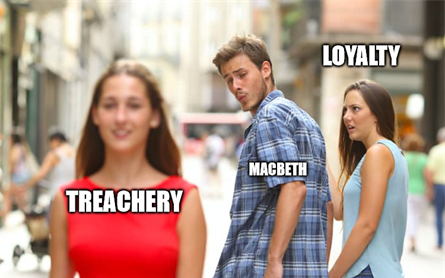
Summary of Act 1, Scene 4:

Macbeth is told that he is the Thane of Cawdor. He later states that becoming a King “is a step on which [he] must fall down, or else o’erleap.” (1.4, 50-51). The scene showed the beginning of Macbeth’s greed that began to flood him.

Significance of this meme:

This meme captures Macbeth’s growing ambition and is likeliness to betray King Duncan after hearing the encouraging prophecies. His loyalty in this scene can be questioned.

Act 1; Scene 5
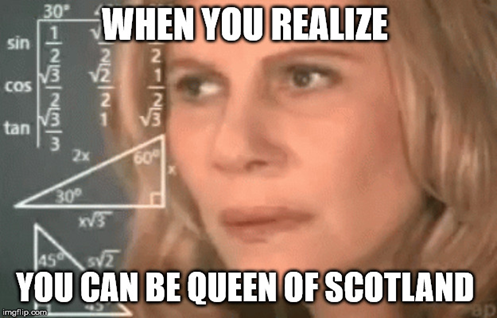
Summary of Act 1, Scene 5:

Lady Macbeth receives a letter from Macbeth that outlines the recent events that occurred. She persuades Macbeth to kill Duncan and fuels him with ambition.

Significance of this meme:

This meme depicts Lady Macbeth’s influence on Macbeth and how her desires can lead Macbeth to ruin. Unarguably, Lady Macbeth’s influence on Macbeth is apparent and it motivates him to commit evil.

Act 1; Scene 6
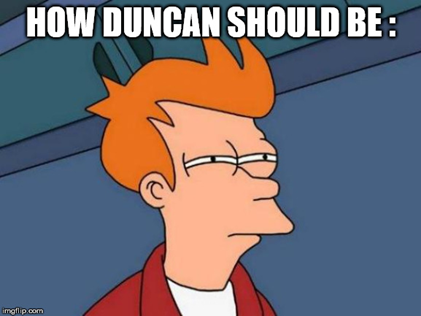
Summary of Act 1, Scene 6:

Duncan is invited to the Macbeth’s house. Lady Macbeth pretends to be welcoming. At this point, Macbeth and Lady Macbeth are plotting to kill Duncan.

Significance of this meme:

Duncan clearly trusts the Macbeths and is unaware of their plans. He should have been more cautious, instead, he overly trusted Macbeth.  

Act 1, Scene 7:

Summary of Act 1, Scene 7:

Lady Macbeth enters and tells her husband that the king has dined and that he has been asking for Macbeth. Macbeth declares that he no longer intends to kill Duncan. Lady Macbeth, outraged, calls him a coward and questions his manhood: “When you durst do it,” she says, “then you were a man” (1.7.49). He then agrees to proceed with the murder.

Significance of this meme:

This scene (and meme) depict Lady Macbeth’s obvious influence on Macbeth. She is the driving force behind this murder, and should be equally at fault.

Act 2, Scene 1
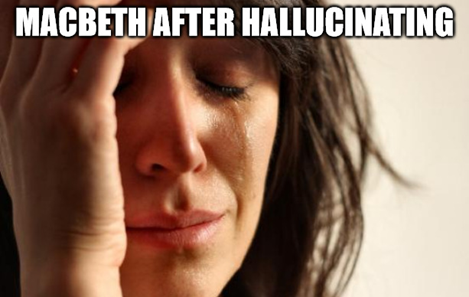
Summary:

Banquo is suspicious of Macbeth; he later hallucinates and sees visions of a floating dagger.

Significance of this meme:

This meme displays Macbeth’s guilt and foreshadows the possible murder of Duncan. The famous dagger scene is key evidence of guilt that overtakes Macbeth along with his guilt-ridden thoughts.

Act 2; Scene 2
Summary:

After the murder pursues, Lady Macbeth tells Macbeth to stop being guilty and tells him to “be a man.” She insists that he should not think of the murder and that her “hands are of [his] color, but [she] shames, to wear a heart so white.”

Significance of this meme:

This scene revolves around the theme of masculinity. Lady Macbeth appears to be stronger than Macbeth, something that was rare during the Elizabethan Era.

Act 2, Scene 3
Summary of Act 2, Scene 3:

Others hear about the murder of Duncan. Macbeth and Lady Macbeth pretend to be shocked about the murder, despite being the murderers themselves. Lady Macbeth faints.

Significance of this meme:

This meme revolves around the theme of appearance vs reality. The Macbeths pretend to be shocked about the murder and appear to be surprised. However, in reality, it is all pretend.

Act 2, Scene 4:

Summary of Act 2, Scene 4:

Suspicion has now fallen on the two princes, Malcolm and Donalbain, because they have fled the scene.

Significance of this meme:

This meme captures how the two princes. Malcolm and Donalbain immediately fled the scene following Duncan’s murder. This is important because it takes some attention away from Macbeth as suspicion has fallen on these two.

Act 3, Scene 1:

Act 3, Scene 1:

Macbeth plots to kill Banquo and hires three servants to do so. He instructs them to kill Banquo and Fleance. He outlines several reasons to persuade and convince the murderers.

Significance of this meme:

This meme highlights Macbeth’s confidence as he independently decides to murder Banquo. Lady Macbeth plays no role in this murder and it seems as if it is getting easier to murder every time.

Act 3, Scene 2:

Summary of Act 3, Scene 2:

Macbeth enters and tells his wife that he too is discontented, saying that his mind is “full of scorpions” (3.2.37). He feels that the business that they began by killing Duncan is not yet complete because there are still threats to the throne that must be eliminated. Macbeth tells his wife that he has planned “a deed of dreadful note” for Banquo and Fleance and urges her to be jovial and kind to Banquo during the evening’s feast, in order to lure their next victim into a false sense of security (3.2.45).

Significance of this meme:

This meme displays Macbeth’s guilt and this scene/meme describes how success achieved through dubious means always leads to unhappiness.

Act 3, Scene 3:
Summary of Act 3, Scene 3:

The murderers kill Banquo, who dies urging his son to flee. One of the murderers extinguishes the torch, and in the darkness Fleance escapes. The murderers leave with Banquo’s body to find Macbeth and tell him what has happened.

Significance of this meme:

This meme portrays the confusion during the murder and how Fleance managed to escape.

Act 3, Scene 4:
Summary of Act 3, Scene 4:

Macbeth sees a ghost of Banquo. Lady Macbeth makes excuses for her husband, saying that he occasionally has such “visions” and that the guests should simply ignore his behavior. The ghost disappears, and Macbeth recovers, telling his company: “I have a strange infirmity which is nothing / To those that know me” (3.4.85–86).

Significance of this meme:

This meme shows the sight that Macbeth witnessed out of guilt and paranoia. This scene, like the dagger scene, represents the affects of guilt and how one can become weak after murder.

Act 3, Scene 5:
Summary of Act 3, Scene 5:

Hecate scolds the witches for meddling in the business of Macbeth without consulting her. She says that when Macbeth comes the next day, they must summon visions and spirits whose messages will fill him with a false sense of security and “draw him on to his confusion” (3.5.29).

Significance of this meme:

Witchcraft, to some extent, seems to have an enormous effect on Macbeth’s actions. His life seems to worsen after this scene.

Act 3, Scene 6:
Summary of Act 3, Scene 6:

Lennox and The Lord discuss recent events and deem Macbeth a traitor. They both express their hope that Malcolm and Macduff will defeat Macbeth.

Act 4, Scene 1:
Summary of Act 4, Scene 1:

The witches present Macbeth with three apparitions that fuel his confidence and allow him to continue committing heinous deeds. He is only motivated by these apparitions and his confidence is renewed. He is told that none of woman borne shall harm him, and that he won’t be defeated until an entire forest moves. However, Macbeth does not think of the first apparition that tells him to be aware of Macduff.

Significance of this meme:

This meme quotes the witches’ line. It states that Macbeth will be presented with “double trouble” from now on.

Act 4, Scene 2:

Summary of Act 4 , Scene 2:

A messenger hurries in, warning Lady Macduff that she is in danger and urging her to flee. Lady Macduff protests, arguing that she has done no wrong. A group of murderers then enters. When one of them denounces Macduff, Macduff’s son calls the murderer a liar, and the murderer stabs him. Lady Macduff turns and runs, and the pack of killers chases after her.

Act 4, Scene 3:
Summary of Act 4, Scene 3:

Malcolm speaks with Macduff, telling him that he does not trust him since he has left his family in Scotland and may be secretly working for Macbeth. To determine whether Macduff is trustworthy, Malcolm rambles on about his own vices. Ross confesses to Macduff that Macbeth has murdered his wife and children. “Macduff is crushed with grief. Malcolm urges him to turn his grief to anger, and Macduff assures him that he will inflict revenge upon Macbeth.”

Significance of this meme:

This meme represents Malcolm’s suspicions about Macduff and suggests that perhaps he is unlike his father, who blindly trusted anyone. Malcolm is careful and cautious about who he trusts.

Act 5, Scene 1
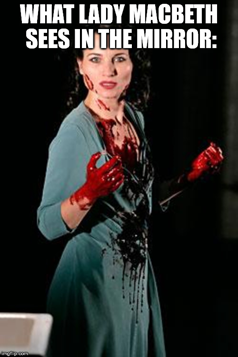
Summary of Act 5, Scene 1:

A doctor and a gentlewoman discuss Lady Macbeth’s strange habit of sleepwalking. Suddenly, Lady Macbeth enters in a trance with a candle in her hand. She seems to see blood on her hands and claims that nothing will ever wash it off.

Act 5, Scene 2:
Summary of Act 5, Scene 2:

Outside the castle, a group of Scottish lords discusses the military situation: the English army approaches, led by Malcolm, and the Scottish army will meet them near Birnam Wood, apparently to join forces with them.

Act 5, Scene 3:
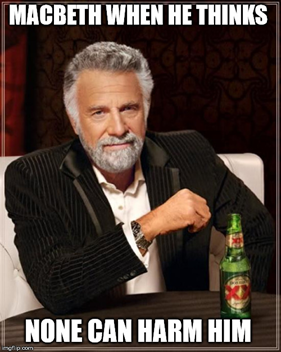
Summary of Act 5, Scene 3:

Macbeth strides into the hall of Dunsinane with the doctor and his attendants, boasting proudly that he has nothing to fear from the English army or from Malcolm, since “none of woman born” can harm him (4.1.96)

Significance of this meme:

This meme is important as it displays the overconfidence that the apparitions have had on Macbeth and how he truly believes that “none of woman borne shall harm him.”

Act 5, Scene 4

Summary of Act 5, Scene 4:

Malcolm talks with the English Lord Siward and his officers about Macbeth’s plan to defend the castle. They decide that each soldier should cut down a bough of the forest and carry it in front of him as they march to the castle, thereby disguising their numbers.


Act 5, Scene 5
Summary of Act 5, Scene 5:

A messenger enters and reports to Macbeth that the trees of Birnam Wood are advancing toward Dunsinane. Macbeth then recalls the prophecy that said he could not die till Birnam Wood moved to Dunsinane.

Act 5, Scene 6:

Summary of Act 5, Scene 6:

Outside the castle, the battle commences. Malcolm orders the English soldiers to draw their swords.

Act 5, Scene 7

Summary of Act 5, Scene 7:

Macbeth finally encounters Macduff. They fight, and when Macbeth insists that he is invincible because of the witches’ prophecy, Macduff tells Macbeth that he was not of woman born, but rather “from his mother’s womb / Untimely ripped” (5.10.15–16). Macbeth suddenly fears for his life.

Act 5, Scene 8:
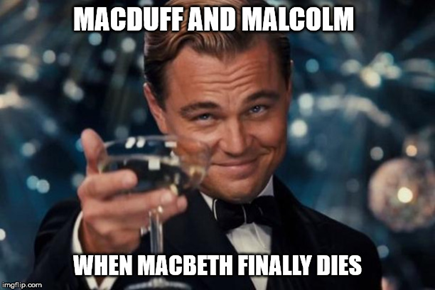
Summary of Act 5, Scene 8:

Macbeth finally dies and Ross tells Siward that his son is dead. Macduff emerges with Macbeth’s head in his hand and proclaims Malcolm King of Scotland.

Thesis:

The eventual downfall and destruction of Macbeth is not just a result of his own actions and choices, but is a direct outcome of the witches’ misguiding visions. The witches plagued Macbeth with questionable prophecies, incomplete apparitions, and destroyed him with their malicious and wicked powers. The witches are clearly one of the the major reasons behind Macbeth’s ruin. 

Macbeth: Act 4 Questions

Discuss the irony of the witches’ statement that “Something wicked this way come.”

The irony of this line is that the witches are calling Macbeth “wicked,” when in reality, they are the ones who are “wicked.” To some extent, Macbeth’s wickedness can be blamed upon the witches’ prophecies. The witches have fueled Macbeth’s wickedness by plaguing him with false hopes. The dramatic irony of this situation is that the audience (and the witches) are aware that Macbeth will be exposed to more evil deeds (or wickedness) after this encounter with the witches. However, Macbeth is definitely not aware of this.

What further evidence is there in this scene that Macbeth has become totally wicked?

The first evidence of Macbeth’s increasing wickedness is apparent when he insists the witches to answer his questions. His lines indicate pure evil:

“I conjure you by that which you profess— Howe’er you come to know it—answer me. Though you untie the winds and let them fight/ Against the churches, though the yeasty waves/ Confound and swallow navigation up/ Though bladed corn be lodged and trees blown down, Though castles topple on their warders’ heads. Even till destruction sicken, answer me. To what I ask you.”

(4.1.50-60)

Macbeth is saying that he doesn’t care if the witches unleash violent winds that tear down churches, make foamy winds, overwhelm ships, send sailors to their death, make castles fall down on their inhabitants’ heads. He just wants to know his future and wants the witches to answer his questions. His evilness is definitely obvious in this sentence.

Macbeth’s evilness and wickedness is also apparent in his reaction to the apparitions. When Macbeth realizes he shouldn’t be afraid of Macduff, he states that he will meet his “assurance double” by killing Macduff anyways.

Summarize the three prophecies that the apparitions give Macbeth. How does he react to them? What does this reveal about Macbeth’s state of mind? How does he react to the show of eight Kings?

The first apparition tells Macbeth to be aware of Macduff. Macbeth’s reaction shows that he was already aware of Macduff’s intentions and wasn’t shocked by it. His reaction was certain and calm. The second apparition tells Macbeth that none of woman born shall harm him. Macbeth is very happy by this information. This leads to some overconfidence. The third apparition tells Macbeth that he won’t be defeated unless an entire forest moves. Macbeth takes reassurance from this apparition as well. When he sees the eight Kings from Banquo’s line, Macbeth is confused, angry, furious, and clearly distressed. The witches visions renew Macbeth’s confidence in his future because the witches previous predictions appeared to work out so much in his favor. Macbeth does not stop to consider that these visions may be incomplete or misleading. Instead, he reacts irrationally and is blinded by his own arrogance. He thinks that last two apparitions assure his victory and blatantly ignores the first prophecy that emphasizes Macbeth to be aware of Macduff.

What dramatic purpose is served by the short scene between Lady Macduff and her son?

Lady Macduff’s troubled emotions result in a somewhat cruel conversation with her son in which she asks the child what he would do if his father were dead. The child asks if his father is a traitor, and the mother says that Macduff is a traitor because he swears and lies. Macduff may be a traitor to a false king, but he is loyal to the true monarchy, which is why he is away now. The son is again clever about the fate of traitors; he says those who cheat and lie far outnumber honest men, and so traitors should have no trouble defeating the honest men. This certainly has been the case in Macbeth so far. This scene allows the audience to understand how Macduff’s family feels about his sudden departure. It allows for one to have some background before the murders ensue.

In what significant ways does the murder of Macduff’s family differ from Macbeth’s previous crimes?

Macbeth murdered Duncan himself and the scenes represented his emotions and guilt quite often. In the murder of Banquo, Macbeth hired some murderers to carry out the task. However, in this murder, it seemed as if plans were made quite fast without much thought or consideration. The reason for the murder was unknown as well. (because Macduff’s murder would be more beneficial as he is his enemy. Fleance’s murder would also be more beneficial because he might be the next king according to the prophecies. The murder of Macduff’s family should be of little value and is very unnecessary.)

How does Malcolm test Macduff’s loyalty? This action of Malcolm’s serves to contrast him with his father. How so? What other comparisons can be made between Malcolm and Duncan?

Malcolm is desperate not to return to Scotland, spinning tales about his debauchery and greed to convince Macduff that he’s not fit to take up his father’s crown. Malcolm proceeds to put Macduff through an extensive test to see if he really is loyal to Scotland. Malcolm pretends to be excessively greedy and unfit to be King. When the murder of Macduff’s family is revealed, Malcolm’s trust in Macduff is verified. Duncan easily trusted Macbeth. However, his son is more cautious with who he trusts and does not make the same mistake as his father.

What lines in the scene reinforce the notion that Macduff will be Macbeth’s nemesis?

All of scene 3 is very significant as it portrays Macduff’s undying passion to save his country from a tyrant leader like Macbeth. Macduff left his family in order to meet Malcolm so they could defeat Macduff. His passion and courage indicates that Macduff will be Macbeth’s greatest nemesis.

Macbeth: Apparitions Scene

What do you think is the symbolism of the apparition’s mirror with the reflections of Banquo’s descendants?

Macbeth asks the three witches if “Banquo’s issue [will] ever reign in this kingdom?” (4.1.113-114) Upon asking, Macbeth is presented with eight kings and Banquo last, with a mirror in his hand. This indicates that Banquo will “father” a long line of Kings. This line of Kings will not only last till eight generations, but beyond that. The mirror is significant as it captures the innumerable amount of Kings from Banquo’s line.

Hecate was an ancient Greek Goddess of crossroads, women and children and witchcraft. As all pagan figures were, she was demonized by the Christian church. Considering different contexts of reception, how do you think her presence in this scene affects the audience’s view of the witches and their intentions? What do you think the witches intentions are?

Hecate is the goddess of witchcraft, and one can view her as the ruler of the Three Witches. In Act 3, Scene 5, Hecate appears before the Witches and demands to know why she has been excluded from their meetings with Macbeth. She tells them that Macbeth will be back to know his destiny and she proclaims that he will see apparitions that will, “by the strength of their illusion” lead him to conclude that he is safe. She plays an important role in the play because of the lines she utters at the end of the scene: “And you all know, security/Is mortals’ chiefest enemy.” She reveals in these lines that Macbeth’s belief that he is untouchable will ultimately result in his downfall. I believe that the witches intentions are to ruin Macbeth by misleading him. Since Act 1, they’ve played an important role in the destruction and downfall of Macbeth by plaguing him with false prophecies and visions.

What do you think is the significance of this scene in terms of Macbeth’s character development? (in terms of his ambitions and the wickedness of his actions)

Macbeth was very curious and ambitious about the future of his throne. His questions for the three sisters and his reactions to the apparitions proved his willingness (to continue to fight) and his evilness. He claimed that “the castle of Macduff I will surprise, Seize upon Fife, give to th’ edge o’th’ sword/ His wife, his babes, and all unfortunate souls/ That trace him in his line. No boasting like a fool.” (4.1.165-170) Macbeth’s vaulting ambition can be seen as he states his desires to raid Macduff’s castle, to seize the town of Fife, and to kill Macduff’s wife and children and anyone else unfortunate enough to stand in line for his inheritance. This line clearly portrays his wickedness; this scene is a huge indicator of character development as it proves Macbeth’s increasing ambition and evilness.

Each apparition is described in a specific way. What do you think each apparition represents?

The first apparition is of an armed head with an armored helmet. This apparition tells Macbeth to be aware of Macduff. This armed head represents the battle that is about to ensue between Macbeth and Macduff. The second apparition is of a bloody child. This apparition tells Macbeth that “none of woman born shall harm him.” It is believed that this bloody child symbolizes Macduff when he was born through a Cesarean section. This can symbolize that the person who will kill and defeat Macbeth will be the one who wasn’t born naturally. The third apparition is of a crowned child holding a tree who tells him that he is safe until Birnam Wood moves to Dunsinane Hill. This apparition representation of the attack on Macbeth by Malcolm.

Do you think the witches are purposely trying to spur on Macbeth and bring him to his fall or do you think they are simply and objectively telling the future as they see it?

I believe that the witches are trying to mislead Macbeth since the beginning of the play. The evil sisters’ plans to plague Macbeth with false prophecies was evident during Hecate’s dialogue in Scene 3, Act 5. She stated that she will “draw him on his confusion” and that “he shall spurn fate, scorn death, and bear his hopes above wisdom, grace, and fear.”

Do you think this scene supports the idea that Macbeth’s fate is unavoidable and out of his control? Or do you think Macbeth’s fall was the result of his own actions? Even at this point (now that Macbeth has committed so many evil deeds) do you think there was anything he could have done to avoid his death?

Macbeth’s downfall and destruction are a direct result of his choices, the witches’ prophecies and Lady Macbeth’s constant persuasion. I believe that Macbeth can not do anything to avoid his death at this point because Macduff and Malcolm seem very determined to overthrow Macbeth. This passage displayed that some things are out of Macbeth’s control, however, Macbeth’s actions and choices are also to be blamed.

Passage Analysis (group work)

Passage Analysis for Scene 1 (lines 90-130)

This passage carries huge significance as it represents Macbeth’s independence and his ability to carry out the murder himself. During the murder of Duncan, Macbeth consulted with Lady Macbeth on several occasions. His hesitance, relunctance, and nervousness were evident. However, in this scene, Macbeth is confident and assertive with his plans. He persuades the murderers by mentioning the hate he carries for Banquo. This passage is significant as it manages to capture Macbeth’s independence and his lack of doubt. It shows how it is becoming easier for him to murder.

Passage Analysis for Scene 6 (lines 10-50)

This passage is significant as it foreshadows events that might occur further on in the play. Lennox and another Lord reveal that the Macduff has fled to England and is mustering a military force to rid “Scotland of Macbeth’s bloody tyranny.” This is an important line as it suggests that Macbeth might be defeated as the King and that Macuff might be crowned King. It also suggests that Macbeth might try to get revenge on Macduff. This scene revolves around the notion of loyalty and tyranny. It indicates that loyalty always wins (in Macduff’s case, he was loyal and might be crowned King) unlike Macbeth who gained power through dubious means.

Passage Analysis: Act 3

Passage Analysis for Act 3, Scene 1: (passage 83-160)

This passage carries huge significance as it illustrates how Macbeth has changed after murdering Duncan. It also revolves around the themes of betrayal and trust, loyalty and tyranny, and the consequences of unchecked ambition. In passage 83, Macbeth is talking to the murderers about murdering Banquo and Fleance. He does this without consulting Lady Macbeth. During the murder of King Duncan, Macbeth was hesitant, doubtful, and afraid. However, in this scene, it is evident that Macbeth is very clear with his intentions and wants no one to get in the way of his throne. Macbeth’s independency is portrayed in this passage as he commands the murderers with ease. This passage also portrays the recurring theme of trust and betrayal. Banquo tells Macbeth that he will be riding horses with Fleance. Even though Banquo believes that Macbeth murdered Duncan, he does not fear his own safety. Banquo easily gives away his location and this makes it easier for him to be murdered. Banquo trusts Macbeth and Macbeth takes advantage of his trust by murdering him for a “fruitless reign.” This revolves around the theme of trust and betrayal.

Passage Analysis for Act 3, Scene 1 (lines 6-30)

This passage carries huge significance as it shows that despite gaining power, the Macbeth’s are still unhappy. Lady Macbeth admits that attaining the throne has not resulted in happiness or peace of mind. She expresses her sadness when she states that “tis safer to be that which we destroy/ than by destruction dwell in doubtful joy.” (3.1.6-10) She is saying that it better to be the one who gets murdered than to be the murderer because of the anxiety, guilt, and doubt that it leads to. Macbeth enters and he too reveals that his mind has been tortured with fears of Banquo. He states that his “mind is full of scorpions.” This indicates that life for Macbeth is worsening as he continues to commit crimes. It is getting easier to murder, however, it is tormenting him more doubt, anxiety, and guilt. This passage suggests that despite having power and authority, one can never reach peace when success is achieved through dubious means.

Passage Analysis for Act 3, Scene 5 (lines 1-30)

Although some believe that this passage wasn’t written by Shakespeare, it still contains some important lines that foreshadow events that might occur further on in the play. Hecate reveals that she is planning to destroy Macbeth by filling him with over-confidence because “security is mortals’ chiefest enemy.” (line 30) Hecate indicates that Macbeth will continue to commit more evil as he will be fueled by the over confidence. This hints that perhaps Macbeth will murder someone important in the next acts. It also suggests that some supernatural forces will never let Macbeth enjoy his reign as he will constantly be faced with troubles. Hecate states that she will “raise such artificial sprites” that will “draw Macbeth onto his confusion.” This suggests that Macbeth will be tormented with more anxiety and guilt. This passage shows just how severe the consequences can be when one is misled by unchecked ambition.

Macbeth: Act 3 Questions

Scene 1: Questions 2,3 & 5:

Question 2-

Banquo was aware of the three witches prophecies and was suspicious of Macbeth’s actions. However, he can only be deemed an accomplice if he was fully aware that Macbeth wanted to kill Duncan. Banquo was suspicious but not certain of Macbeth’s intentions. He even tried to question Macbeth’s motives in act 2, scene 1 when he mentioned thinking about the witches. In act 3, scene 1, Banquo states that Macbeth “played’st most foully for ’t.” (Line 3). At this point, Banquo suspects Macbeth of cheating to win the titles. Even after the murder ensued, not once did Banquo state with full conviction that he believes Macbeth is the murder. Instead, he always doubted whether Macbeth was the murderer or not. Banquo is not an accomplice because he wasn’t fully aware about what Macbeth could do to achieve this title. His silence only represents his uncertainty about Macbeth’s actions, not his willingness to partake in the murder.  Another important factor to consider is that Banquo, without any hesitation, told Macbeth that he would be riding horses with Fleance. If Banquo truly knew that Macbeth was the killer, he would fear his own safety and not let Macbeth be aware of his location. Hence, Banquo can not be considered as an accomplice.

Question 3-

Macbeth offers many reasons as to why he wanted Banquo murdered. He begins by stating that his “fears in Banquo stick deep.” (2.1.54-55) He fears Banquo will father a line of kings. Macbeth also states that Banquo is willing to take risks and his mind never stops working. He also believes that Banquo has wisdom to act bravely but also safely. (“He hath wisdom that doth guide his valor”) Macbeth also believes that he has tortured his own conscience and murdered the gracious Duncan for Banquo’s sons. (Lines 55-65). These are some of the reasons that Macbeth puts forth to murder Banquo.

Question 5-

Macbeth was hesitant to carry out Duncan’s murder. Lady Macbeth was also involved in the murder and carried a huge role in convincing and persuading Macbeth. However, in Banquo’s murder, Macbeth was seen as more active, confident, and assured with his plan than before. The three servants were hired to murder Banquo and it seemed as if Macbeth was more ambitious and less reluctant than the previous murder. It seems as if it is easier for Macbeth to murder now. He is making independent decisions and carrying out the murder without consulting Lady Macbeth.

Scene 2: Question 1

Lady Macbeth states that “Naught’s had, all’s spent/ where our desire is got without content. ‘Tis safer to be that which we destroy/ than by destruction dwell in doubtful joy” (3.2.6-10). Lady Macbeth states that if you get what you want and you’re still not happy, you’ve spent everything and gained nothing. She believes that it’s better to be the person who gets murdered than to be the killer and be tormented with anxiety. In this scene, it is evident that the Macbeth’s are unhappy even after attaining the crown. The anxiety, torment, doubtfulness, and uncertainty are all reasons for their unhappiness. The crown seems fruitless which results in disappointment. Anxiety and torment are the product of murdering, especially a loved one.

Scene 4: Questions 1 & 4

Question 1-

Macbeth’s downfall begins as soon as he hears that Fleance has escaped. He then sees the ghost of Banquo which causes a series of guilt-ridden moments. Visions of Banquo’s ghost represent the guilt, fear, and paranoia that consume Macbeth. In addition, Macbeth notices Macduff’s absence from the banquet. This scares him because he fears that Macduff is beginning to doubt him.

Question 4-

Macbeth in the beginning can be described as a fearless and confident man but after seeing the ghost, he can be seen as a weak, doubtful, and delusional character. If one was at the banquet, they would describe Macbeth’s actions as foolish and dramatic. The frightening scene causes Macbeth to act in a foolish manner and this is not beneficial for him since other characters can guess that Macbeth is guilty of a crime.

Scene 5: Question 1

Hecate’s speech reveals that Macbeth will be fooled into thinking he is greater than fate, he will mock death, and he will think he is above wisdom, grace, and fear. Hecate states that “security is mortals’ chiefest enemy.” In other words, she is indicating that overconfidence will lead Macbeth to ruin.

Scene 6: Questions 2,3 & 4

Question 2-

The Lord reveals that Macduff has fled to England to join up with Malcolm, who is mustering a military force to rid of Scotland of Macbeth’s blood tyranny.

Question 3-

I think that Macbeth is going to kill Macduff and Fleance next. Macbeth feels threatened by Fleance (as mentioned in his speech to the three murderers in scene 1). Macduff is also a loyal addition to the play and is a character that Macbeth used to be.

Question 4-

In this scene, Lennox hints at his belief that Macbeth is responsible for the deaths of the king and Banquo. The purpose is to let the audience know that Macbeth’s people do not trust him, foreshadowing his eventual downfall.


Thinking Questions for Act 1

Foreshadowing: a literary device in which a writer gives an advance hint of what is about to come later on in the story. It often appears at the beginning of a story, or a chapter, and it helps the reader develop expectations about the upcoming events.

Allusion: a brief or indirect reference. (to a person, place, thing, cultural or political idea, etc.)

Two examples from Act 1 that can be argued to be foreshadowing future events:  

Most of the major events in the play are foreshadowed before they take place, although the hints can be misleading or hard to interpret.

In the beginning of the play, the Thane of Cawdor, attempts to raise a rebellion against King Duncan in order to gain the throne for himself. The rebellion is defeated, but these events hint that the political state of the kingdom is unstable and foreshadow Macbeth’s own plot to gain power. The foreshadowing becomes even more explicit when Macbeth is awarded the title of the Thane of Cawdor himself. The audience suspects that Macbeth is going to follow in the footsteps of the man who previously held the title.

In act 1, scene 3, the witches present Macbeth and Banquo with three prophecies. They predict that Macbeth will be the Thane of Cawdor, and eventually become the King of Scotland. They also predict that Banquo will become the ancestor to a line of kings without actually ruling himself. This indicates that his son might be the king. These prophecies can potentially be hints at what might occur further on in the play.

Find an allusion to Shakespeare in a popular medium of your generation:

At the end of Toy Story 3, all the toys get together and not only reference but put on a stage performance of Romeo and Juliet. There is a snippet of the infamous ‘balcony scene’ with hedgehog as Romeo and Little Green Man as Juliet. He quotes ‘But soft what light through yonder window breaks’ and the LGM quotes “Romeo oh Romeo wherefore art thou Romeo.” Both lines come from Act 2 Scene 2, one of the most famous of Shakespeare’s scenes.

What is unnatural about Macbeth’s desires?

In Act 1, scene 7, Macbeth states, “To our own lips. He’s here in double trust: First, as I am his kinsman and his subject, Strong both against the deed; then, as his host, who should against his murderer shut the door, Not bear the knife myself. ” Macbeth states that he should not murder the King because he is his kinsman and his subject, so he should protect King Duncan. Secondly, he is the host. These reasons make it unnatural for Macbeth to kill King Duncan. Macbeth was characterized as generous, hardworking, and loyal in the beginning of the play. These traits make it unnatural for him to desire authority.

Fair is foul, and foul is fair.

The phrase, “fair is foul, and foul is fair” is chanted by the three witches in the beginning of the play. This phrase has several meanings. It can indicate that the notion of good and bad is reversed. Or, that one shouldn’t judge purely based on face value. When Banquo and Macbeth first saw the witches, they were horrified and thought that they were “ugly creatures.” But once they heard the prophecies, they didn’t want them to leave and were persistent to hear more.

Why did Shakespeare choose to make the transition so quick?

Shakespeare chose to make the transition so quickly to show how appearances can be deceiving. Macbeth’s victories displayed his hardworking and loyal self. But the plotting to overthrow the king shows how maybe the first impression wasn’t very true. The real “drama” of this tragedy is loyal and treachery.

Evidence from Act 1 that suggest Lady Macbeth is an unnatural woman.

Some of Lady Macbeth’s unnatural behaviors include her summoning of the spirits of darkness to help with the murder, her willingness to kill a child if necessary, and her encouraging the murder of Duncan.


Macbeth Act 2- Questions

Scene 1: questions 1-3

The use of pathetic fallacy created a very dark tone for the reader. It insinuates that a bad event is about to occur as the scene becomes intense. In act 2, scene 1, Fleance states that the moon is not visible to which Banquo replies that there aren’t any stars in the sky. This sets a dark and ominous tone. Pathetic fallacy is seen in the “Lion King” and also in many of Shakespeare’s plays such as Romeo and Juliet. The weather indicates the emotions of the characters in the play. This use of pathetic fallacy helps enhance the experience of the reader.

Macbeth says “If you shall cleave to my consent/ When ’tis, it shall make honour for you.” (2.1.31-32). Macbeth is saying that if Banquo were to act the way he instructed when the time comes, it could increase his honour. Banquo replies by saying that he is unwilling to do anything that will improve his situation that might ultimately reduce how honourable he is. Banquo’s statement makes the reader assume that he suspects Macbeth will do something that will “reduce his honour.” This scene in the play plays an important role as it displays Banquo’s suspicion towards Macbeth’s actions.

When Macbeth was walking towards Duncan’s chambers, he seemed to be hesitant, guilty, and a bit unconfident with his abilities. This was evident when he said “A dagger of the mind, a false creation/ proceeding from the heat-oppressed brain?” (2.1.46-47). This line proves his self-doubt as Macbeth questions his feverish and “heat-oppressed” brain’s abilities. The bloody dagger that he sees in front of him represents his guilt.

Scene 2: questions 1, 3, and 4

1 & 3: Lady Macbeth is characterized as a strong and fearless character who can manipulate her husband into doing “evil.” However, Lady Macbeth seemed not as strong when she stated that she would have murdered Duncan “had he not resembled [her] father.” (2.1.14-15). This line indicated that Lady Macbeth does to some extent have sympathy, at least towards those she loves. Lady Macbeth believes that thinking too deeply of the murder will make her and Macbeth “mad.”

4: Macbeth seems to be paranoid and guilty of what he has just done. He claims that sight of the murder was a “sorry sight” to which Lady Macbeth disagrees. At the end of the scene, Macbeth states that he’d rather be unconscious than think about the crime he committed. This line is important to empathize because it displays that Macbeth still has emotions and that ambition hasn’t fully destroyed him. However, this scene makes Lady Macbeth appear more insane and manipulative.

Scene 3:  question 3

3. Lady Macbeth would do anything to save her husband. Since anyone can suspect Macbeth of killing Duncan, Lady Macbeth wanted to divert everyone’s attention away from Macbeth. She had already known about Duncan’s murder, so it should not bring such a shock that she would faint. Lady Macbeth’s fainting was an act that was put forth to save Macbeth. Macbeth stated that he killed the chamberlains. This was not the original plan. Lady Macbeth decides to faint before he can give away more details.

Scene 4: question 1 & 2

Various unnatural events occur before and after the murder of King Duncan. According to Lennox, “the night has been unruly.” (2.4.28) He stated that the wind blew down the chimneys where people were sleeping. The owl also made a noise all night. Some people stated that the earth shook as if it had a fever. It was also rumored that the horses ate each other.

Macduff seems to doubt Macbeth. He immediately distrusts Macbeth’s claim that Duncan was killed by his servants, and refuses to go to Macbeth’s coronation. Macduff seems to be the loyal one, he seems to be a character that Macbeth once was.

In Text Citing and Quote Sandwiches: Questions

Analyze the ‘dagger speech’ in Act 2, Scene 1 beginning at line 41 and going until the end of the scene. How does it illustrate the guilt Macbeth is feeling?

The “dagger speech” expresses Macbeth’s hesitancy and guilt. Macbeth questions whether or not the dagger is actually in front of him. He states that it can be a “dagger of the mind, a false creation/ proceeding from the heat oppressed brain.” (2.1.46-47) This indicates Macbeth’s hesitancy as he is aware that his feverish or “heat-oppressed” brain might be misleading him. This line also depicts Macbeth’s guilt. He is confronted with an image of the same weapon that he will use to kill King Duncan. Hesitation is also evident when Macbeth states that his “eyes are made the fools o’ th’ other senses/ or else worth all the rest. (2.1.45) Macbeth is saying that his eyesight must either be the one sense that’s not working, or else it’s the only one that’s working right. This line portrayed hesitation as Macbeth begins to doubt his eyesight and his sanity. Macbeth’s guilt manifests in the hallucination of a dagger. As he continues to hallucinate, the “dagger of the mind” begins to drip with blood, a symbol of guilt. Despite his guilt and hesitation, Macbeth proceeds to Duncan’s room to murder him:

“I go, and it is done. The bell invites me.” (2.1.70)

Analyze Lady Macbeth using her line from Act 2, Scene 2.  What does her dialogue say about her character?

Lady Macbeth can be characterized as an evil, bold, and fearless character in the play. She states that “had he not resembled my father as he slept, I had done ’t. (2.2.14-15). This line indicates Lady Macbeth’s aggressiveness and how easily she can commit evil. She shows no pity for Duncan and tells Macbeth that “its a foolish thought, to say a sorry sight.” (2.2.28) This shows Lady Macbeth’s lack of sympathy as she insists Macbeth to not “consider it so deeply” (2.2.38). She shows her boldness and fearless self when she takes the daggers herself so she can place them with the servants. She then proceeds to tell Macbeth that her “hands are of his color, but I shame to wear a heart so white” (2.2.65). Lady Macbeth is indicating that Macbeth has a weak and fragile heart and that she would be ashamed to “wear” a heart so pure. This shows her villainous and malicious side.

Use the Porter scene in Act 2, Scene 3 to explain the role off comic relief in a play.  Why is the seem supposed to be funny?

A porter stumbles through the hallway to answer the knocking, grumbling comically about the noise and mocking whoever is on the other side of the door. He compares himself to a porter at the gates of hell and asks, “Who’s there, i’ th’ name of Beelzebub?” (2.3.3). Comic relief is necessary because it lessens the tension of a scene in the play and provides some entertainment in moments of stress, tension, and distress. This was especially common during the Elizabethan Era.